-
Recent Posts
Recent Comments
- Eleanor Rabnett, Lay Oblate on THROUGH A GIFT OF THE FATHER OUR OBLATE FAMILY CHOOSES THE WAY OF THE EVANGELICAL COUNSELS (C12)
- Eleanor Rabnett, Lay Oblate on THE EVANGELICAL COUNSELS ARE INDISPENSABLE (C12)
- Eleanor Rabnett, Lay Oblate on ALL MEMBERS OF THE OBLATE CHARISMATIC FAMILY CHOOSE THE WAY OF THE EVANGELICAL COUNSELS (C12)
- Eleanor Rabnett, Lay Oblate on BEATITUDES: TO CONTINUALLY RENEW OURSELVES IN THE SPIRIT OF OUR VOCATION (C11)
- Eleanor Rabnett, Lay Oblate on LEAVEN OF THE BEATITUDES AT THE HEART OF THE WORLD (C 11)
Archives
Meta
-
EUGENE 101 BACK ONLINE
A few years ago, the Kusenberger Chair of Oblate Studies, at Oblate School of Theology, produced a series of sixteen 20-minute videos on the life, spirituality and mission of St. Eugene de Mazenod. Together with each presentation there is a paper with suggestions for reflection, prayer and sharing.
The series proved to be very popular, especially as an instrument for the formation of lay members of the Oblate Charismatic Family.
The material has been available for several years, but recently the original website collapsed. I thus make the material available now through this “Eugene de Mazenod Speaks to us” website.
The link is https://www.eugenedemazenod.net/?page_id=6397

Posted in WRITINGS
Leave a comment
THROUGH A GIFT OF THE FATHER OUR OBLATE FAMILY CHOOSES THE WAY OF THE EVANGELICAL COUNSELS (C12)
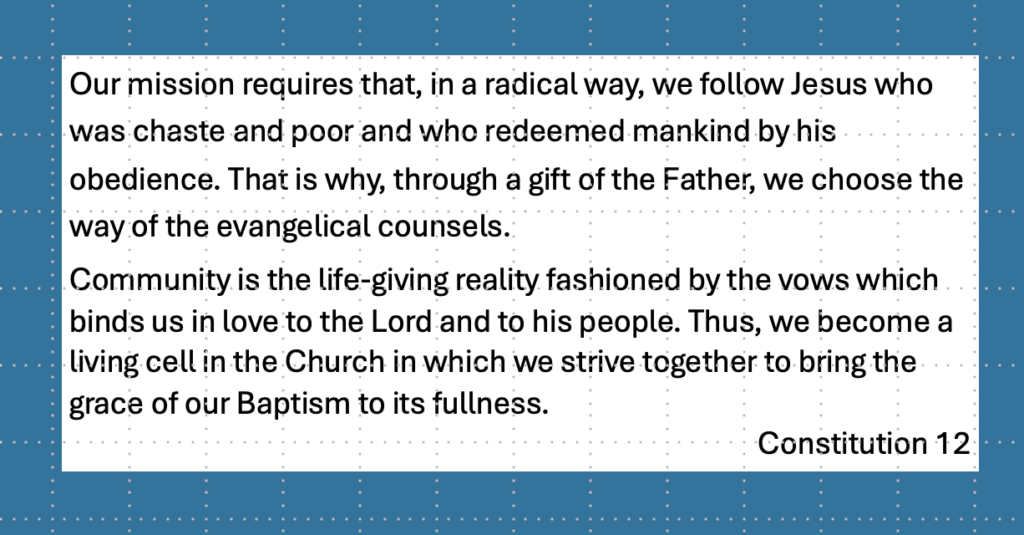
Our mission requires that, in a radical way, we follow Jesus who was chaste and poor and who redeemed mankind by his obedience. That is why, through a gift of the Father, we choose the way of the evangelical counsels.
Constitution 12
Father Jetté commented:
Our mission is to be co-workers with Christ in the work of evangelizing the poor. Now, to accomplish this work, Jesus Christ chose to live chaste, poor and obedient and he invited his disciples to follow him in this same way, provided God calls them and gives them the grace thereto. “No one can come to me unless the Father who has sent me draws him” (John 6:44).
“If anyone wants to come after me, let him deny himself, take up his cross and follow me” (Matthew 16:24). We go on mission by passing through Jesus, through the mystery of his renunciation, and our missionary activity will be the more effective in the measure that our life itself is a stronger witness of the life of Jesus.
Jesus it is who saves the world, not the Oblate, unless the latter truly becomes “another Jesus Christ”. The way of the evangelical counsels, oriented as it is towards the perfection of love, is the road par excellence for becoming other Jesus Christs.”
Our missionary vocation is indeed a gift! How blessed we are.
JESUS REDEEMED US THROUGH OBEDIENCE (C12)
Our mission requires that, in a radical way, we follow Jesus who was chaste and poor and who redeemed mankind by his obedience. That is why, through a gift of the Father, we choose the way of the evangelical counsels.
(Constitution 12)
On Holy Thursday, April 11, 1816, Eugene and Henri Tempier took a further step in living the evangelical counsels by making a mutual vow of obedience.
Hence I considered choosing the evangelical counsels, to which they had been so faithful, as indispensable, lest our words be no more than what I have noticed about the words of those who proclaim the same truths, namely sounding brass and tinkling cymbals. My consistent thought has even been that our little family should consecrate itself to God and to the service of the Church through the vows of religion… Briefly put, Father Tempier and I felt that we should not delay any longer, and on Holy Thursday … we pronounced our vows with an indescribable joy.
Eugene’s Memoires, quoted in Rambert, I p. 187
Each time we renew our commitment as members of the Oblate Family, we are asked to recall this founding inspiration.
Posted in WRITINGS
Leave a comment
THE EVANGELICAL COUNSELS ARE INDISPENSABLE (C12)
Our mission requires that, in a radical way, we follow Jesus who was chaste and poor and who redeemed mankind by his obedience. That is why, through a gift of the Father, we choose the way of the evangelical counsels.
(Constitution 12)
Eugene insisted:
My intention in dedicating myself to the ministry of the missions to work especially for the instruction and conversion of the most abandoned souls, was to follow the example of the Apostles in their life of devotedness and self-denial… Hence I considered choosing the evangelical counsels, to which they had been so faithful, as indispensable, lest our words be no more than what I have noticed about the words of those who proclaim the same truths, namely sounding brass and tinkling cymbals.
Eugene’s Memoires, quoted in Rambert, I p. 187
In this sprit, for all of us today, following the counsel of poverty aims at detachment from consumerism and materialism and develops generosity.
Following the counsel of chastity aims at purity in a world saturated with the misuse of sexuality and proposes fidelity.
Following the counsel of obedience aims at counteracting the cult of the ego, autonomy and pride and proposes following the will of God and rightful authority.
ALL MEMBERS OF THE OBLATE CHARISMATIC FAMILY CHOOSE THE WAY OF THE EVANGELICAL COUNSELS (C12)
Our mission requires that, in a radical way, we follow Jesus who was chaste and poor and who redeemed mankind by his obedience. That is why, through a gift of the Father, we choose the way of the evangelical counsels.
(Constitution 12)
From the start we need to clarify that the evangelical counsels are not just the “vows’ that religious make, but that they apply to everyone.
The invitation of Jesus to follow him means to accept his invitation to holiness. We do this, not only by living according to his commandments, but also by the counsels which are a special path to follow Jesus more closely and radically. We do this by imitating three aspects of his life: his chastity, his poverty and his obedience.
All of us are invited to live our baptism in this light according to our state of life in marriage, the single life or religious life. In the case of the Oblate brothers and priests, we bind ourselves to these counsels by making vows.
St. Francis de Sales wrote: “You may practice the counsels according to the measure of your state in life; for while not everyone is called to renounce all things, all are called to prefer God above all things” (Introduction to the Devout Life).
St Eugene de Mazenod is an excellent example of this radical choice of God which he proposed to his Oblate Family:
If we wish to achieve the same results as the Apostles and the first followers of the Gospel we must use the same means as they and, this all the more because we do not have the power to perform miracles and so we must bring back those who have gone astray by the splendor of our virtues.
Letter to M. Arbaud, 1 January 1819, EO XIII n 22.
BEATITUDES: TO CONTINUALLY RENEW OURSELVES IN THE SPIRIT OF OUR VOCATION (C11)
Growing in faith, hope and love, we commit ourselves to be a leaven of the Beatitudes at the heart of the world.
(Constitution 11)
“Do this and you will live” are the words of Jesus. “Do this and you will live” are the words with which our Constitutions and Rules are entrusted to us.
In the Gospel, Jesus teaches us the beatitudes as an evangelical itinerary for our lives and a source of happiness for each of us.
For Eugene, they were contained and expressed in the Rule.
My dear sons … take in hand, once and for all, the Rule that the Church has given us and be imbued with its spirit. I ask you: to what have the members of our Institute devoted themselves, what have they sworn to be for their entire life? Listen: “They must wholly renounce themselves, and strive solely for the glory of God, the good of the Church and the growth and salvation of souls. They must continually renew themselves in the spirit of their vocation
Eugene’s Circular Letter to all Oblates, 2 February 1857, EO XII p. 209 f

LEAVEN OF THE BEATITUDES AT THE HEART OF THE WORLD (C 11)
Together we await Christ’s coming in the fullness of his justice so that God may be all in all (cf. 1 Cor 15: 28).
Growing in faith, hope and love, we commit ourselves to be a leaven of the Beatitudes at the heart of the world.
(Constitution 11)
The lives and symbolic actions of the Biblical prophets bore witness. They were men and women who interpreted situations through the eyes of God and spoke on behalf of God. The goal of their words and actions was conversion, to invite people to the liberation and salvation offered by God. Eugene saw the world through the eyes of the Crucified Savior and became the instrument of the charism given to the Church: “that those in whom he continues to suffer will know also the power of his resurrection” (C 4). It is summed up in the Preface’s injunction to lead people: “to act like reasonable persons (rendre les hommes raisonnables), first of all, and then to act like Christians, and, finally, we must help them to become saints.”
In the Preface, Eugene stressed the necessity for prophetic witness:
“Take great care about what you do and what you teach,” was Paul’s charge to Timothy, “Always do this, and thus you will save both yourself and those who listen to you” (1 Tim 4: 16).
Being witnesses of God’s mercy and divine justice is an integral part of who we are as Oblates, and our mission of being “co-operators of the Savior” is part of the prophetic mission of the Church: being witnesses to the new world born in his resurrection.
(A Companion to the OMI Constitutions and Rules – Reflections by the Oblate Charismatic Family, p. 181-182, https://www.omiworld.org/wp-content/uploads/Oblatio-Studia-14.pdf)
SO BE ALWAYS WHAT YOU OUGHT TO BE (C 11)
We fulfil this mission in community; and our communities are a sign that, in Jesus, God is everything for us. (Constitution 11)
The community is missionary in the example it gives to outsiders. Speaking of the ministry of the community of Notre Dame de l’Osier to priests:
“People vie with one another in their admiration for the regularity, good order, piety that reign in the house… They find edification in everything: the silence that reigns in the house. the punctuality at all the exercises, the office, the small refectory penances. So be always what you ought to be and never let the presence of strangers bring you to make changes in anything whether it be in the Rule or in our customs. If one can find in your house no more than a group of priests living under the same roof, as pastors from the surrounding neighbourhood might do, you will be guilty-before me before the Congregation and before God; and the people for whose sake you surrendered your Oblate way of life will go away but little edified and certainly deceived in their expectations.”
“Community” in the Dictionary of Oblate Values, https://www.omiworld.org/lemma/community/#_Ftnt43
“We fulfil our mission in and through the community to which we belong. Our communities, therefore, are apostolic in character… By growing in unity of heart and mind, we bear witness before the world that Jesus lives in our midst and unites us in order to send us out to proclaim God’s reign.”
Constitution 37.